
Every deck quote we run in Spring Hill eventually arrives at the same fork: pressure-treated wood or capped composite? Both are good decks when built right. They just trade money for maintenance in opposite directions — and Florida's climate makes that trade sharper than anywhere up north. Here's the honest comparison, with the numbers we quote every week.
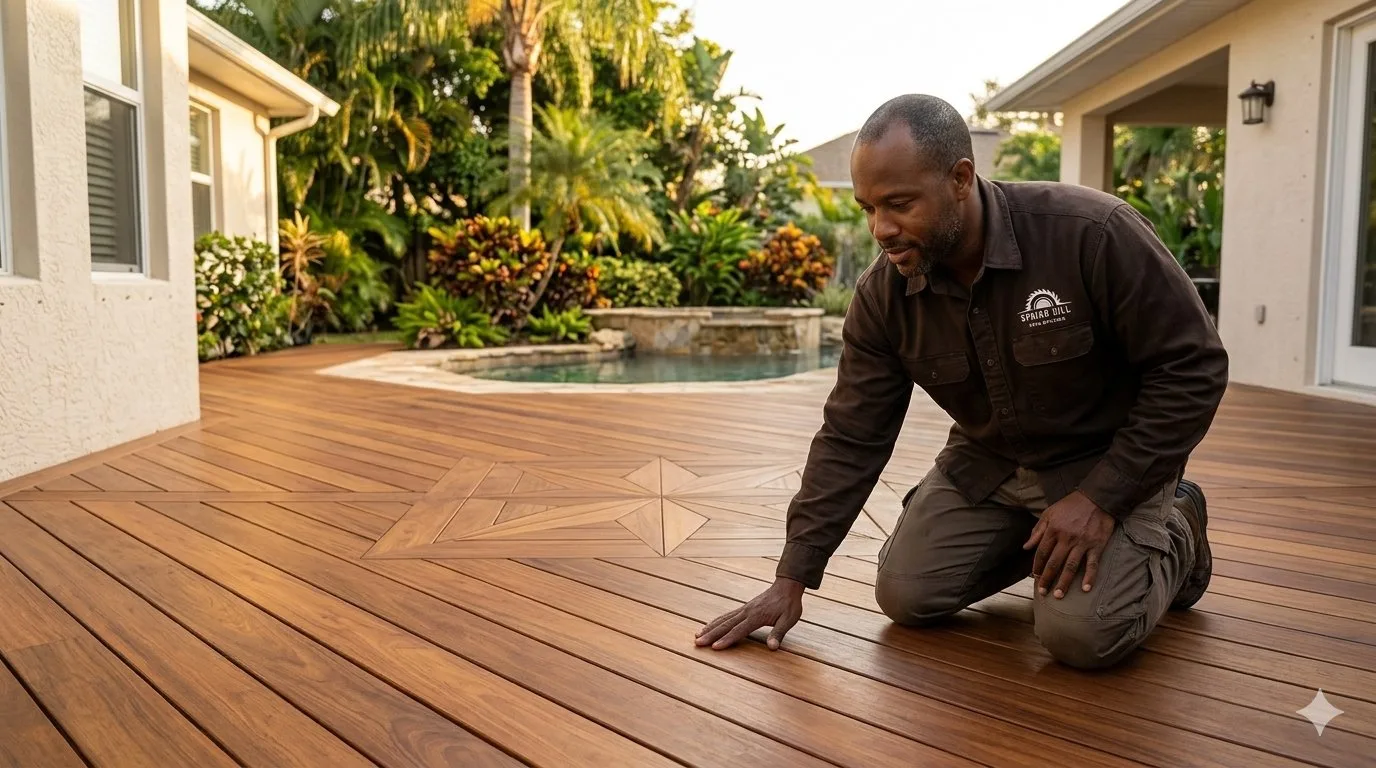
Upfront Cost: Wood Wins
No contest here. Pressure-treated pine runs $30–$45 per square foot installed in Spring Hill; capped composite runs $50–$65. On a 12x16 deck that's roughly $8,000 versus $13,000 — a real gap, especially if you're decking a big footprint. Full breakdown in our Spring Hill deck cost guide.
Maintenance: Composite Wins, And It's Not Close
Florida is the hardest place in America to own a wood deck. Ten months of UV grays and checks the boards, summer rain swells them, and humidity feeds rot at every cut and fastener. Keeping a wood deck nice here means cleaning twice a year and re-sealing every 12–18 months — $300–$600 in materials or $600–$1,200 hired out, forever.
Capped composite's maintenance program: rinse it. The polymer cap doesn't absorb water, doesn't feed mildew, doesn't gray, and never sees a stain brush. That difference compounds every single year you own the deck.
The 10-Year Math
- Wood: $8,000 build + 7 sealing cycles (~$3,500 hired out) + a board/railing refresh around year 10 (~$1,500) ≈ $13,000
- Composite: $13,000 build + soap and water ≈ $13,000
Same money, ten years later — except the composite deck still looks new and carries 15–40 more warranty years, while the wood deck just had its first refresh. Stretch to 15 years and composite pulls clearly ahead. The only scenario where wood wins the long game is if you genuinely enjoy maintenance or plan to sell within a few years.
Heat, Feel and Looks
Heat: the honest knock on composite. Dark boards in July sun get uncomfortably hot — but so does dark-stained wood. Lighter colorways and heat-mitigating lines stay close to wood temperatures; around pool decks we spec those by default and bring sun-baked samples so you can feel it.
Feel and looks: modern capped composite has realistic grain and matte finishes that fooled most of our clients' neighbors. Purists can still tell. Real wood feels like real wood — and looks like it too in year one. The question is year six, when un-maintained wood is gray and the composite hasn't changed.
Hurricanes and Structure
Worth knowing: this debate is about the deck surface. Underneath, both get the identical pressure-treated frame, engineered to Hernando County wind code with hurricane-rated hardware. Composite boards are actually heavier and their hidden-fastener systems grip well in storms — but a deck's storm survival is decided by its frame and footings, which is where we never compromise regardless of your decking pick.
Our Recommendation
Choose wood if: budget rules, you're decking a large area, you'll keep up with sealing, or you plan to sell soon.
Choose composite if: you're staying 7+ years, the deck surrounds a pool, or the words "annual sealing" made you tired. Most of our Spring Hill clients who can stretch to composite never regret it — we've never once been called to convert composite back to wood.
Wood vs Composite FAQs
Does composite decking last longer than wood in Florida?
Is composite decking too hot for Florida?
How much more expensive is composite than wood?
Can I put composite boards on my existing wood frame?
What maintenance does composite decking actually need?
Feel The Difference Yourself
Samples beat blog posts. We bring wood and composite boards to every free quote — including ones that have been baking in a Florida truck bed — anywhere in Spring Hill and Hernando County. Call (352) 453-8259.